
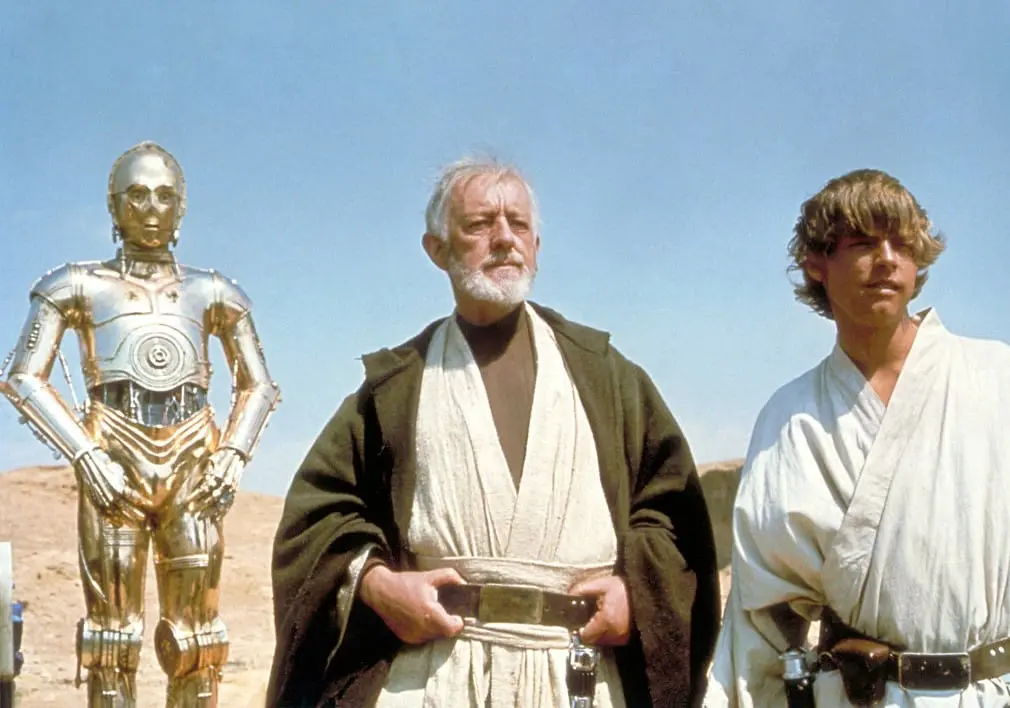
In 1976, an illustrious actor faced a dilemma when approached by an up-and-coming director with a script he deemed unworthy. This choice led him to star in a film that would redefine his legacy and become one of the highest-grossing films of all time. Sir Alec Guinness initially had reservations about “Star Wars,” but a savvy negotiation paved the way for a financial triumph that would span decades, establishing a benchmark for Hollywood contracts.
The Reluctant Beginning
In 1976, Sir Alec Guinness was already a celebrated figure in the film industry, known for his Oscar-winning performance in “The Bridge on the River Kwai” and a remarkable career that included over fifty films and numerous Shakespearean roles. However, when he received a script from a relatively unknown director named George Lucas, he was less than impressed. Describing it as “clunky fairy tale rubbish,” Guinness was hesitant to engage in what appeared to be a trivial B-movie.
Despite his misgivings, including a lack of interest in being linked to such a production, Guinness faced financial pressures common among actors. Lucas was aware that securing an actor of Guinness’s caliber could lend credibility to the film. To lure him in, the studio offered a substantial salary of $150,000, equivalent to about $850,000 today. However, Guinness’s thoughts ran deeper than just a paycheck.
Negotiating for More
The actor’s agent recognized that the standard salary wasn’t adequate for an icon like Guinness. He returned to Lucas and 20th Century Fox with a bold proposition: a share of the film’s gross revenues, known as “backend points.” This request was atypical for an actor of his status in a project that many expected would not succeed. Nevertheless, the studio was eager to have a renowned performer like Guinness and agreed to the terms, granting him 2% of the film’s box office profits, plus an additional 0.25% from Lucas’s share.
When “Star Wars” debuted on May 25, 1977, in a mere 32 theaters, it quickly defied expectations. It grossed over $300 million during its initial run, making it the highest-grossing film of that era. In his diary, Guinness expressed his hopes regarding the film’s success, joking that it could yield significant returns. Little did he know, his 2.25% share would result in more than $7 million — an extraordinary profit for less than 20 minutes of screen time.
Long-Term Financial Gains
What set Guinness’s deal apart was its enduring nature. His 2.25% stake in the film meant that every re-release, sequel, or spin-off added to his financial gains. When “The Empire Strikes Back” was released in 1980, he made a brief return for a single day of filming, but most of his income was already secured. His earnings continued to grow with the franchise’s expansions, accumulating an estimated $100 million by the time of his passing in 2000. Today, that figure could reasonably be closer to $150 million for his estate due to continued offerings from Disney and new productions.
Lessons from the Legacy
Alec Guinness’s initial doubts about “Star Wars” turned out to be misplaced. His film career skyrocketed with the role of Obi-Wan Kenobi, transforming what he anticipated would be a low point into a landmark achievement. Guinness’s decision to negotiate for backend points has since become a model for actors, setting a precedent for stars like Jack Nicholson and Robert Downey Jr. to follow in securing lucrative contracts.
Ironically, not all actors experienced similar success. James Earl Jones, known for his iconic Darth Vader voice, faced a starkly different fate. Offered points instead of a salary, he opted for immediate cash, receiving just $7,000 for his role — a decision he regretted in retrospect. Meanwhile, Steven Spielberg, recognizing the potential of “Star Wars” while working on his own project, engaged in a friendly wager with Lucas for backend points that ultimately favored him, showcasing the varied outcomes of contract negotiations within the industry.

John is a seasoned journalist at The Bothside News, specializing in balanced reporting across news, sports, business, and lifestyle. He believes in presenting multiple perspectives to help readers form informed opinions. His work embodies the publication’s philosophy that truth emerges from examining all sides of every story.


