
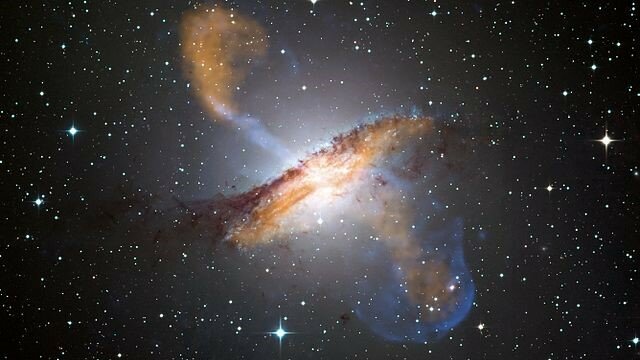
An astronomical team has discovered a unique black hole that is spewing a fiery jet at another galaxy. The black hole is hosted by RAD12, a galaxy one billion light years away from Earth.
Galaxies are classified into two types based on their morphology: spirals and ellipticals. Spirals have optically blue spiral arms with a lot of cold gas and dust. New stars form at a rate of one Sun-like star per year on average in spiral galaxies. Elliptical galaxies, on the other hand, appear yellowish and lack distinguishing features such as spiral arms.
Star formation in elliptical galaxies is extremely rare; astronomers are still baffled as to why the elliptical galaxies we see today have not been forming new stars for billions of years. Evidence indicates that supermassive or’monster’ black holes are to blame. These’monster’ black holes spew massive jets of electrons travelling at extremely high speeds at other galaxies, depleting the fuel needed for future star formation: cold gas and dust.
RAD12’s singularity was discovered in 2013 using optical data from the Sloan Digitised Sky Survey (SDSS) and radio data from the Very Large Array (FIRST survey). However, additional observations with India’s Giant Meterwave Radio Telescope (GMRT) were required to confirm its truly exotic nature: The black hole in RAD12 appears to be ejecting the jet only towards RAD12-B, a neighbouring galaxy. Jets are ejected in pairs, moving in opposite directions at relativistic speeds in all cases. Astronomers are baffled as to why only one jet can be seen coming from RAD12.
A conical stem of young plasma is ejected from the centre and extends far beyond the visible stars of RAD12. According to the GMRT observations, the fainter and older plasma extends far beyond the central conical stem and flares out like a mushroom cap (seen in red in the tricolour image). The entire structure is 440 thousand light years long, much longer than the host galaxy.
RAD12 is unlike anything previously observed; this is the first time a jet has been observed colliding with a large galaxy such as RAD12-B. Astronomers are now one step closer to understanding how such interactions affect elliptical galaxies, which may leave them with little cold gas for future star formation.
“We are excited to have discovered a rare system that helps us understand radio jet feedback of supermassive black holes on star formation in galaxies during mergers,” says research lead Dr. Ananda Hota. GMRT observations and data from other telescopes, such as the MeerKAT radio telescope, strongly suggest that the radio jet in RAD12 is colliding with the companion galaxy. The demonstration of public participation in making discoveries through the RAD@home Citizen Science research collaboratory is also an important aspect of this research.”
(source : ANI)


