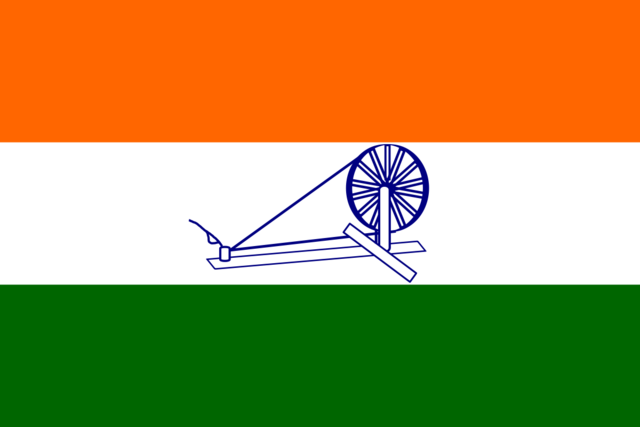
On this day, history creates by giving Bharat an amazing meaning itself by adopting the new symbol through the National Flag. The National Flag is based on the Swaraj flag, a flag of the Indian National Congress also designed by Pingali Venkayya.
The National Flag of India was adopted in its present form during the meeting of the Constituent Assembly held on 22 July 1947, 75 years ago today, a few days before India’s independence from the British on 15 August 1947.
It went through several changes, and in 1931, Congress adopted the ‘Swaraj’ flag as the national flag of India. The colour saffron replaced red and the order of the colours was changed, and it was devoid of any religious interpretation. However, the flag had already become the symbol of the Independence movement by then.
Mahatma Gandhi designed the Swaraj Flag in 1921. It was a tricolour (red, green, white) flag and had a spinning wheel in the centre. It represented Gandhi an ideal of self-help. Three colours of the flag stated red stood for the sacrifice of the people, white for purity and green for hope. It was also called the Swaraj flag, the Gandhi flag and the Charkha Flag.
Also, it represented the unity of religions and peace. The red stripe was for Hindus, and the green was for Muslims. The white band represented peace and the rest of the communities living in India.
Although the first national flag in India is said to have been hoisted on August 7, 1906, in the Parsee Bagan Square (Green Park) in Calcutta now Kolkata. The flag was composed of three horizontal stripes of red, yellow and green. It had 8 lotuses which represented 8 provinces, and a crescent moon representing Hindus and Muslims.
THE OLD NATIONAL FLAG
Today we proudly unfold the flags on our Independence Day as well as on Republic Day and every National celebration.