Amazon: "We still need humans" despite the spread of robots
Robotics has not escaped the company's cost-cutting focus as concerns about an impending economic recession have grown and the company's sales have slowed. Amazon shut down its drone programme in the UK this year and shelved some of its robotics projects, including Scout, which was developing a machine that could deliver packages to people's homes. The company's hiring freeze also applies to its robotics division, Mr. Brady noted, adding, "We're totally aware of the macroeconomic conditions out there." We're not going to ease up on investments, he added.
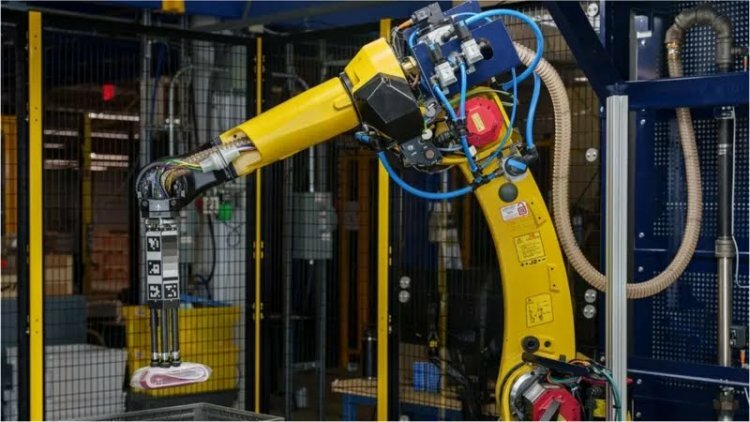
Amazon is using robots more frequently as demand for cost-cutting measures increases and sales growth slows.
Already, some sort of robotic device has handled nearly three-quarters of the parcels that the e-commerce behemoth has delivered.
Tye Brady, the chief technologist at Amazon Robotics, told the BBC that this is, however, likely to reach 100%, or almost, in the following five years.
The business chose not to disclose how much the investments lower costs.
In response to inquiries about how soon humans will be replaced by machines, the staff was quick to point out that as technology has advanced, 700 new types of roles have been created.
Jobs will undoubtedly change, but there will always be a need for people, according to Mr. Brady.
Mr. Brady spoke at an event where the company showcased its most recent lineup of robots, drones, and mapping technologies to a gathering of media at its robotics hub outside of Boston, Massachusetts.
The company is testing a large robotic arm that can pick up items before they have been placed in boxes, a capability that executives have dubbed a major breakthrough, as well as a machine that can freely move on the warehouse floor alongside people.
Later this year, it will begin making its first drone deliveries in the US.
According to Joe Quinlivan, vice president of robotics fulfilment and IT, "I genuinely think what we're going to do in the next five years is going to dwarf anything we've done in the prior 10 years." "We believe it will significantly change our network,"
Amazon is somewhat late to the robot party.
Nearly five years ago, the Chinese e-commerce behemoth JD.com unveiled a warehouse manned by only four employees, while rival Walmart already has a drone delivery programme in place.
In a historic UK vote, Amazon employees fall short of the strike threshold.
Amazon may compensate UK customers with £900 million.
Companies all along the supply chain are investing heavily in these projects, partly as a result of the labour shortage, according to Dwight Klappich.
He declared, "There's a lot of creativity going on. "This could be any industry, any size business,"
Amazon has apparently been working on such initiatives for more than ten years, and reportedly warned in an internal email last year that it would run out of workers to hire for its US warehouses by 2024.
In order to kickstart its effort, it acquired Boston-based robotics company Kiva Systems in 2012. The company's founder, Jeff Bezos, spoke about the company's drone ambitions in a 2013 interview.
More than twice as many mobile drive robots as in 2019 are already scooting across the warehouse floors, according to Amazon. And to sort goods at locations in the US and Europe, it has placed approximately 1,000 of a previous model of its robot arm.
The robots the company displayed on Thursday are still in the trial phase, but deployments are anticipated to increase over the following two years.
By the end of the decade, the business said it hoped to use drones to transport 500 million parcels yearly, even to densely populated locations like Seattle.
However, that will still represent a very small portion of the 5 billion shipments the business claims it presently processes annually.
Robotics has not escaped the company's cost-cutting focus as concerns about an impending economic recession have grown and the company's sales have slowed.
Amazon shut down its drone programme in the UK this year and shelved some of its robotics projects, including Scout, which was developing a machine that could deliver packages to people's homes.
The company's hiring freeze also applies to its robotics division, Mr. Brady noted, adding, "We're totally aware of the macroeconomic conditions out there." We're not going to ease up on investments, he added.
What's Your Reaction?