Einstein’s Theory of Relativity was confirmed after Light behind the black hole was detected for the first time.

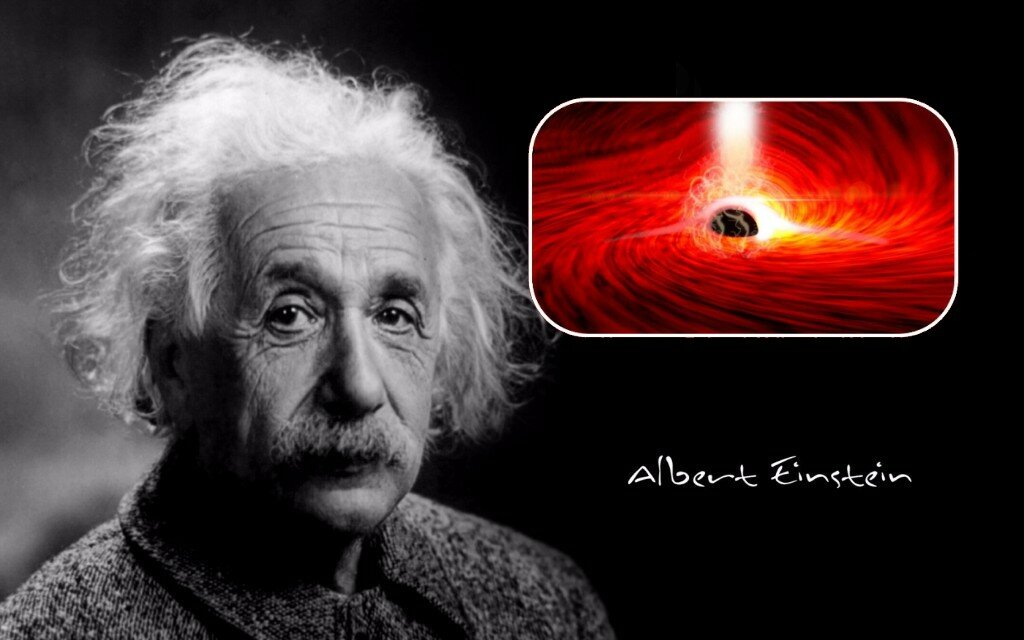
Scientists have detected light behind a black hole for the first time. It fulfills a prediction rooted in Albert Einstein’s theory of relativity as photons bent around the black hole.
It has been known that any light that goes into the black holes does not come out and cannot be seen again. However, astrophysicists believe that they were able to see the light because black holes warp space and bend the light as it twists the magnetic field around it.
A black hole is formed from the death of a star with such a high gravitational field that the matter gets squeezed into a small pace under it, trapping the light of the dead star. The gravity becomes very strong in the process. Since no light can get out, people can’t see black holes, therefore they remain invisible.
Researchers have spotted bright X-Ray flares emerging from a supermassive black hole at the center of another galaxy, which is said to be nearly 800 million light-years away.
It was a mere coincidence when the light was detected when the researchers were studying the feature known as the corona.
The researchers published in the journal Nature reported the observation of X-Rays flares emitted from around the supermassive black hole and its accretion disk. The black hole’s extreme gravitational field redirects and distorts light coming from different parts of the disk.
“The energy shifts of these photons identify their origins from different parts of the disk. These are photons that reverberate off the far side of the disk, and are bent around the black hole and magnified by the strong gravitational field,” researchers said in the paper.
“Fifty years ago, when astrophysicists starting speculating about how the magnetic field might behave close to a black hole, they had no idea that one day we might have the techniques to observe this directly and see Einstein’s general theory of relativity in action,” said Roger Blandford, study coauthor and the Luke Blossom Professor in the School of Humanities and Sciences and professor of physics at Stanford University, in a statement.
However, researchers are hopeful that once the Advanced Telescope for High-Energy Astrophysics (ATHENA), an X-ray observatory being developed by the European Space Agency (ESA) becomes operational, they will be able to do observations in higher resolution and would also know how these massive objects lying at the center of almost every galaxy.