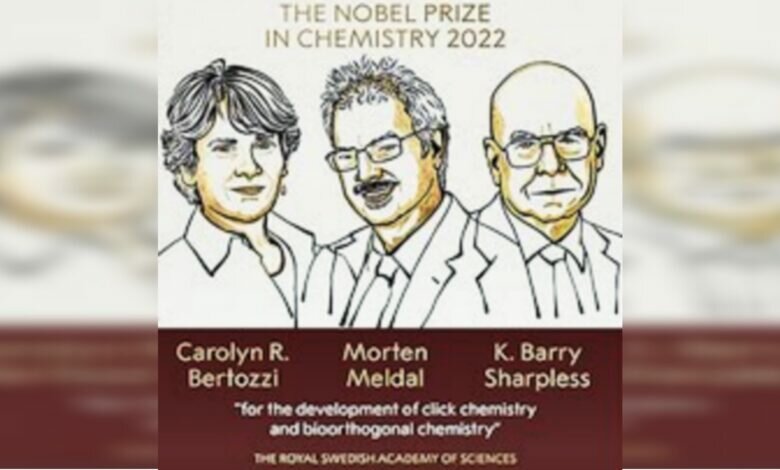
A team of chemists from the US and Denmark who built the groundwork for a more functional form of chemistry were given the Nobel Prize in Chemistry on Wednesday.
The judges awarded Morten Meldal of Denmark, Carolyn Bertozzi, and Barry Sharpless of America “for the creation of click chemistry and bioorthogonal chemistry.”
For 81-year-old Sharpless, who earned the chemistry Nobel in 2001, the honour represents his second Nobel.
Only four other people, including Marie Curie, a Frenchwoman of Polish descent, have accomplished the feat.
The jury stated in a statement that “click chemistry is an elegant and efficient chemical reaction that is already in widespread application.”
It was also used to map DNA, produce medications, and make materials that were better appropriate for their intended application, among many other things, the statement continued.
According to a statement from Johan Aqvist, chair of the Nobel Committee for Chemistry, “this year’s Prize in Chemistry deals with not overcomplicating problems, instead working with what is easy and simple.”
At a formal ceremony in Stockholm on December 10, the anniversary of the scientist Alfred Nobel’s death in 1896, who established the prizes in his last will and testament, the trio will each receive ten million Swedish kronor ($917,500) as their share of the Nobel Prize. They will be presented with their awards by King Carl XVI Gustaf.
According to the panel, Sharpless, a professor at Scripps Research in California, “coined the notion of click chemistry” about 2000. The jury stated that “shortly after, Morten Meldal and Barry Sharpless, independently of each other, presented what is today the gem in the click chemistry crown: the copper catalysed azide-alkyne cycloaddition.”
Professor of chemistry at the University of Copenhagen, Meldal is 68 years old.
“She created internal click reactions for use in living things. Her bioorthogonal processes occur without altering the cell’s regular chemistry, “the jury declared
Minutes after the revelation, Bertozzi called reporters and said, “I’m utterly surprised; I’m sitting here and I can hardly breathe.”
David MacMillan, a dual citizen of the United States and the United Kingdom, and Benjamin List, a scientist from Germany, were recognised by the academy last year for creating asymmetric organocatalysis, a precise method for building molecules.
Svante Paabo, a Swedish paleogeneticist, received the medical prize on Monday for his research into the development of humans and the genomes of extinct hominins.
Then, on Tuesday, the physics prize was awarded to Austrian Anton Zeilinger, John Clauser, and Alain Aspect of France for creating the experimental techniques that helped demonstrate quantum entanglement, a phenomena that Albert Einstein regarded as “spooky action at a distance.”
The highly anticipated literary and peace prizes, which will be presented on Thursday and Friday, respectively, will come after the chemistry award.
This year’s peace prize is anticipated to have extra significance in light of Russia’s invasion of Ukraine.