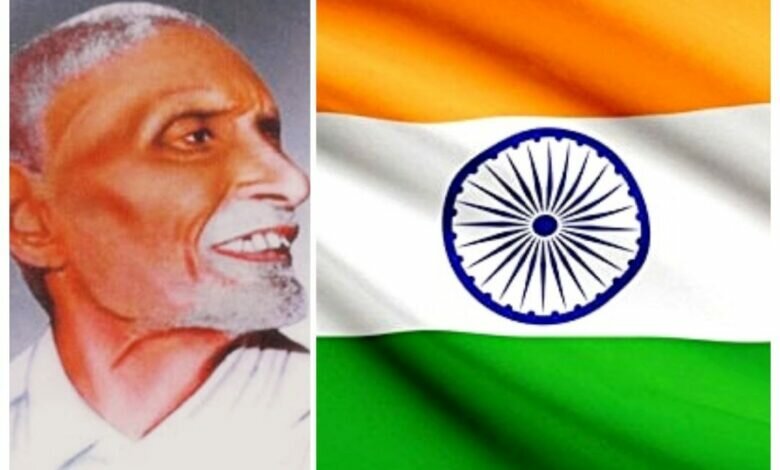
The designer of the Tricolor, Pingali Venkayya, was born on August 2, 1878, which is 146 years ago. Life was never simple for Venkayya. He would later go on to become a teacher, an agriculturalist, an author, and a linguist, although he always had financial difficulties.
According to a Times of India report, despite having created India’s famous national flag, Venkayya never capitalised on his recognition and spent a challenging life where he battled to make ends meet. He lived in a cottage that was constructed on property that was given to him for his military service in Chittinagar.
The report claims that Venkayya’s son Chalapathi Rao passed away after he fought to obtain him medical attention. The creator of the Tricolor was drawn to the military services as a young guy growing up in rural Andhra Pradesh. When he was 19 years old, Venkayya enlisted in the British Indian Army and fought in the South African Boer War. He met Mahatma Gandhi there.
Dadabhai Naorogi presided over the 1906 AICC session in Calcutta, and when Venkayya attended, he was inspired to create a flag for the Indian National Congress since he disagreed with the practise of displaying the British flag during Congress gatherings.
Over 25 flag designs were created, each with a unique meaning and connection to Indian culture, heritage, and history.
Venkayya completed Gandhi’s request for a flag design submission at the Bezwada AICC meeting.
The two major communities in India—Hindus and Muslims—were represented by two colour bands on the draught that Venkayya gave to Gandhi. Gandhi, however, advised including a white ring to signify harmony and peace across communities, in addition to a spinning wheel to signify the nation’s progress.
It was adopted as the nation’s official flag on August 15, 1947. The Ashoka Chakra, a 24-spoke wheel in navy blue, is positioned in the middle of the horizontal, rectangular Tricolor flag, which is made up of the colours saffron, white, and green.
Indigent and impoverished, Venkayya passed away in 1963. He was mostly ignored by society. He was honoured with a postage stamp in 2009, and it was suggested that he get the Bharat Ratna posthumously in 2011.