Abdel Fattah el-Sisi, the president of Egypt, was invited to Republic Day 2023 as the chief guest
As a bridge connecting Africa and West Asia, which New Delhi refers to as being in its extended neighborhood, Egypt holds a strategic position for India.
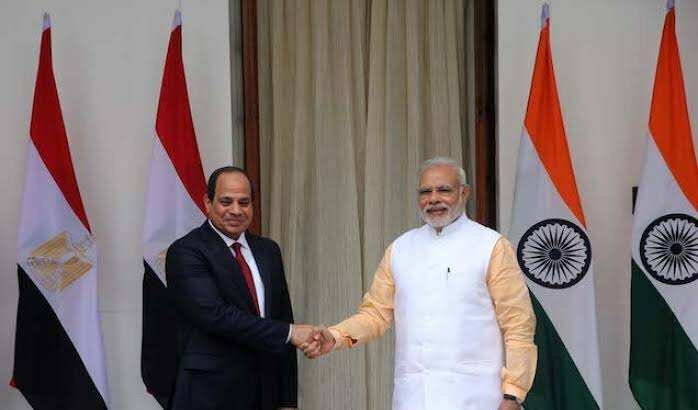
As it gets ready for a year of high-profile diplomatic engagements, India has invited Egyptian President Abdel Fattah el-Sisi to be the chief guest for Republic Day in 2023, according to people with knowledge of the situation. This shows New Delhi's continued focus on the Arab world. The official invitation was given when Sisi and the minister of external affairs met on October 16 in Cairo, according to the sources. One of the nine guest nations invited to the G20 Summit in 2023 while India holds the presidency is Egypt.
A top guest invitation for the Republic Day festivities on January 26 is a significant honour designated for the nation's close allies and partners. The Covid-19 pandemic created significant disruptions in 2021 and 2022, which is why there were no chief guests for the festivities. Jair Bolsonaro, a former president of Brazil, was the final chief guest to attend the 2020 festivities.
Jaishankar tweeted last month that he had delivered "warm greetings from PM @narendramodi and handed over a personal message" during his meeting with Sisi. The issue has not yet been formally announced by any nation. Despite the fact that India and Egypt have had close ties in the past, particularly since both countries were founding members of the Non-Aligned Movement in 1961, the 68-year-old general-turned-politician is expected to be the first Egyptian leader to be hosted by India for the Republic Day celebrations. The invitation to Sisi, according to Talmiz Ahmad, a former Indian ambassador to Saudi Arabia, Oman, and the United Arab Emirates, appeared to be motivated by a number of factors, including Egypt's recovery from a serious economic crisis, its independent foreign policy, and its expanding role in Africa. This is a step toward rebuilding a very important traditional relationship that has been weakened over the past 20 years, he said. When India's attention shifted to the Gulf nations due to interests like oil, trade, investments, and the presence of millions of expatriates, Ahmad added, Egypt faced serious domestic political challenges including the Arab Spring protests and a terrible economic crisis. But over the past three to four years, Egypt appears to have recovered and has begun to assert its influence. It has also taken significant initiatives that are independent of the Gulf nations, such as its stance on Syria, Yemen, and Turkey. Egypt has improved ties with Iraq and initiated communication with Iran, he continued.In recent years, defence and security cooperation has become a major pillar of India-Egypt relations. When Rajnath Singh visited Cairo from September 19 to 20, he also met Sisi.
In a memorandum of agreement on increasing defence cooperation across all sectors, General Mohamed Zaki and Singh of Egypt agreed to identify concepts for enhancing collaboration between their countries' defence industries. The two sides also decided to increase their joint training exercises and military personnel exchanges, particularly for counterinsurgency training.According to reports, Egypt is considering buying 70 jet fighters and has its eyes on India's domestic Tejas light combat aircraft. Mahmoud Foaad Abd El-Gawad, the commander of the Egyptian Air Force, travelled to India in July to look for military hardware. The first air force exercise between the two nations took place in October 2021 after that.
As a bridge connecting Africa and West Asia, which New Delhi refers to as being in its extended neighborhood, Egypt serves a strategic role for India. India has historically been one of Africa's most significant trading partners, and in 2020–21 India ranked as Egypt's eighth-largest trading partner.
Prior to falling to $3.23 billion in 2016–17 as a result of the general economic slowdown and drop in oil prices, bilateral trade reached a high of $5.45 billion in 2012–13. From 2017 to 2018, trade increased positively once more, reaching $4.15 billion in 2020 to 21.
What's Your Reaction?