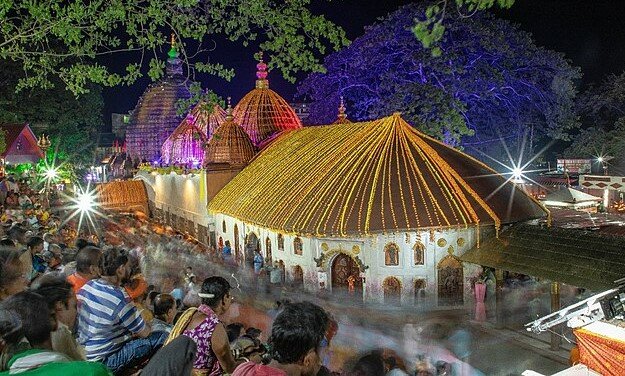
After a two-year hiatus, full-fledged Durga Puja celebrations are now taking place at Assam’s famous Kamakhya temple, which is perched above the Nilachal hills. According to Kamakhya Devalaya president Kabindra Sarma, the hills were silent over the past two years while all rites connected to the fortnight-long worship of the goddess were carried out on a rotating basis by a group of chosen priests. At the same time, the temple doors were closed to outsiders.
In contrast to the rest of the country, where it is celebrated for 9–10 days, the Kamakhya temple, regarded as a significant site of Shakti worship, commemorates the yearly Durga Puja ceremonies, locally known as “Pakhuvapuja,” for a fortnight or “paksa.” After two incredibly challenging years, he remarked, “we are extremely glad that devotees are coming in great numbers to offer prayers and seek the goddess’ graces.” Sarma claimed that in addition to from all around the nation, devotees also travel from neighbouring Nepal.
Aniket Pandey, a final-semester engineering student, was eagerly anticipating his trip to the temple. In a year when I’m gearing up for job placements, I’m pleased to seek the goddess’ blessings, he remarked. Since she got married three years ago, another devotee, Priyanka Sonowal from Dibrugarh, had planned to visit the temple, but COVID limitations proved to be a barrier. She explained, “I, together with my family, are travelling to the Vaishno Devi Temple in Jammu and Kashmir, but we first wanted to pay our respects to Maa Kamakhya.
According to Sarma, Durga Puja is a significant celebration held at the temple and is thought to have originated in antiquity, though its precise genesis is unknown. The puja’s most notable feature is its lack of a Goddess Durga image; instead, ceremonies are carried out in the main “pitha,” or sanctum sanctorum. According to a past office-holder of the Devalaya, the Durga Puja typically takes place between mid-September and mid-October and begins on the ninth day of the waning moon, or “Krsna Navami,” and finishes on the ninth day of the waxing moon, or “Sukla Navami,” of “Asvina.”
(source : PTI)