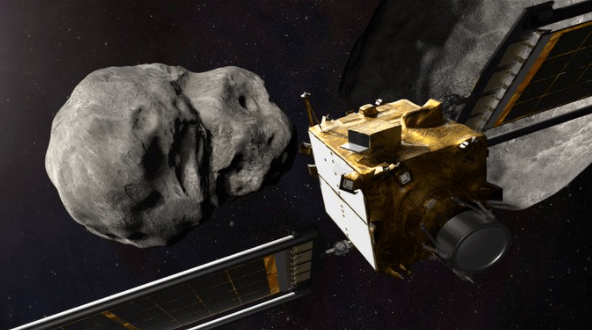
Earlier this month, China informed the United Nations General Assembly that its manned space station had to adjust its orbit in order to avoid collision with satellites launched by SpaceX, calling on the world body to remind the United States “to bear responsibility” as per global treaties.
First reported by The Guardian, which cited experts as saying the Chinese action was unusual, the incident spotlights the growing risk in space, where orbital room is being crowded out by an astronomical race in which nation-states as well as private companies are increasingly active.
Behind it are projects such as the Elon Musk-owned SpaceX’s Starlink constellation and rival Amazon’s Project Kuiper. Both companies want to create a web of low-earth orbit (LEO) spacecraft that will beam down internet connectivity to anywhere on the planet.
And then there are several countries – Russia and India being the most recent – that have carried out tests of satellite-killing missiles, generating millions of pieces of debris.
Scientists said such developments not only increase the risk of collisions, but – particularly the satellite constellations — raise the chances of interference with astronomical research.
The space rivalry between the U.S. and China has been heating up in recent years. Earlier this month a top Chinese scientist said his nation may be able to send astronauts to the moon for the first time by 2030. Those comments came just weeks after President Joe Biden’s top space official set out a similar timetable for new American lunar exploration, setting up the possibility of dueling missions between two of the world’s best-financed space powers.
Both China and the U.S. are signatories to the space treaty, which holds nations “responsible for national space activities whether carried out by governmental or non-governmental entities.” It also says states are liable for damage caused by their space objects.
In October last year, a dead Soviet satellite and a discarded Chinese rocket body narrowly avoided a crash. A collision would have led to an explosion equivalent to detonating 14 metric tons of TNT, Jonathan McDowell, an astrophysicist at the Harvard-Smithsonian Center for Astrophysics, tweeted at the time.
More recently, seven astronauts and cosmonauts living on board the International Space Station (ISS) were forced to take shelter in their transport spacecraft on November 15 after a Russian anti-satellite test created a debris field in low-Earth orbit.
Days later, Nasa called off a spacewalk on November 30, after receiving a notification that debris could threaten the astronauts outside ISS.
In response, Musk tweeted, “We had to shift some Starlink satellite orbits to reduce probability of collision. Not great, but not terrible either.”