Increased trade between Russia and India ushers in a new age for the Silk Road
Indian exports to Russia totaled $992.73 million. The establishment of partnership links between the countries in recent years,
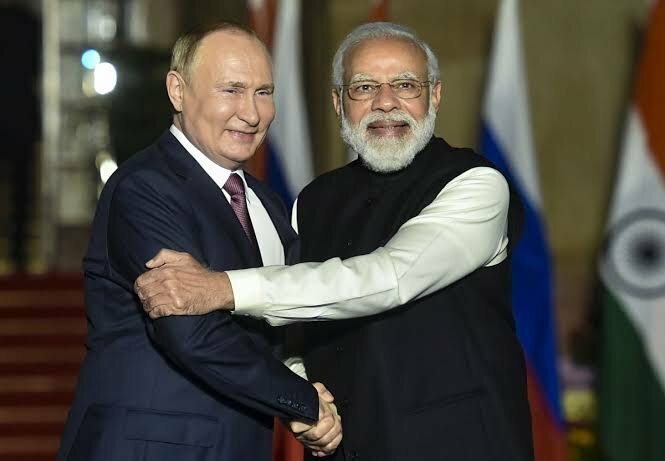
According to the Observatory of Economic Complexity, a worldwide trade statistics platform, India boosted monthly imports from Russia by 433% during the previous five years. According to India's Ministry of Industry and Commercial, trade turnover between Russia and India exceeded $18.2 billion in the first five months of the fiscal year. With a total commercial turnover of $13.1 billion in 2021, Russia has risen from 25th to seventh place as the country's seventh largest trade partner.
Between April and August, India's imports from Russia totaled $17.2 billion, while Indian exports to Russia totaled $992.73 million. The establishment of partnership links between the countries in recent years, as well as the initiation of transportation via the International North-South Transport Corridor (INSTC), have greatly contributed to bilateral trade growth. "The contact is becoming beneficial to our economies. Many gains have been made under Prime Minister Modi's leadership in recent years, and commerce between our countries is increasing. Prime Minister Modi, for example, asked me to offer more fertilisers, which are critical for Indian agriculture. And that is exactly what we did. We raised our fertiliser shipments to India by 7.6 times. 7.6 times, not 7.6 percent, "Vladimir Putin stated.
He also stated that agricultural commodity trade between the two countries had more than doubled. "Indian entrepreneurs should take advantage of the current European crisis to establish economic links with Russia," S. Former State Bank of India CEO Adikesavan (SBI). "After the West imposed anti-Russian sanctions, trade turnover rose between Russia and India; commerce in INR and RUB will help India lessen its reliance on the US dollar," he stated
Increased Russian energy exports have already enabled India to pursue its energy alleviation plan, while trade growth has enabled the country to boost its GDP and become a world economic leader. International economic and transportation corridors, such as the INSTC, are critical to these efforts. Speaking at an international conference on Central Asia in Bishkek, Professor Agnieszka Kuszewska of the Polish Institute of Middle and Far East noted that the 7,200-kilometer-long INSTC serves as a geostrategic alternative to China's New Silk Road envisioned by the Belt and Road Initiative.
According to the professor, INSTC has the ability to significantly boost India's geostrategic position in the region, enhancing its prospects of countering China's expansionism, while collaboration with Iran and Central Asian countries would allow Indian shipments to transit Pakistan. The INSTC's expanding importance in bilateral trade is driven not only by sanctions against Russia, but also by shifts in economic centres. According to Andrei Belousov, First Deputy Prime Minister of the Russian Federation, the longitudinal transport infrastructure connecting Russia and neighbouring countries no longer meets global trends, with latitudinal routes, particularly the North-South route, now playing a vital role. Belousov also feels that the corridor has the potential to become a full-fledged competitor to the Suez Canal.
"By 2030, we expect to treble the amounts of Russian freight flowing through the INSTC, reaching 32 million tonnes as opposed to the present 17 million tonnes," said Russia's First Deputy Prime Minister. "We also have high aspirations for the western route that travels through Azerbaijan." "For Russia, the INSTC is a powerful, landmark trade route that will bring us closer to Iran and India, the two key players at this time," said Konstantin Andrianov, associate professor at the State University of Management, member of the Russian Academy of Natural Sciences, and expert at the Russian State Duma.
According to the expert, India is currently the economic growth leader and has the potential to become the world's largest economy, outpacing even China's development. Once fully operational, the INSTC will allow India to fully meet its need for energy, metals, and military equipment, reducing delivery time and cost. Furthermore, the country would benefit from increased international collaboration in new and promising sectors and businesses such as aluminium, medicines, and food exports.
(source : IANS)
What's Your Reaction?